The Economy Says Growth. The Consumer Says, “Let Me Think About It.”
Market Watch
Understanding the gap between economic growth and consumer spending in Kenya

Kenya’s economy is growing. But for many consumers, it may not necessarily feel like things are getting easier.
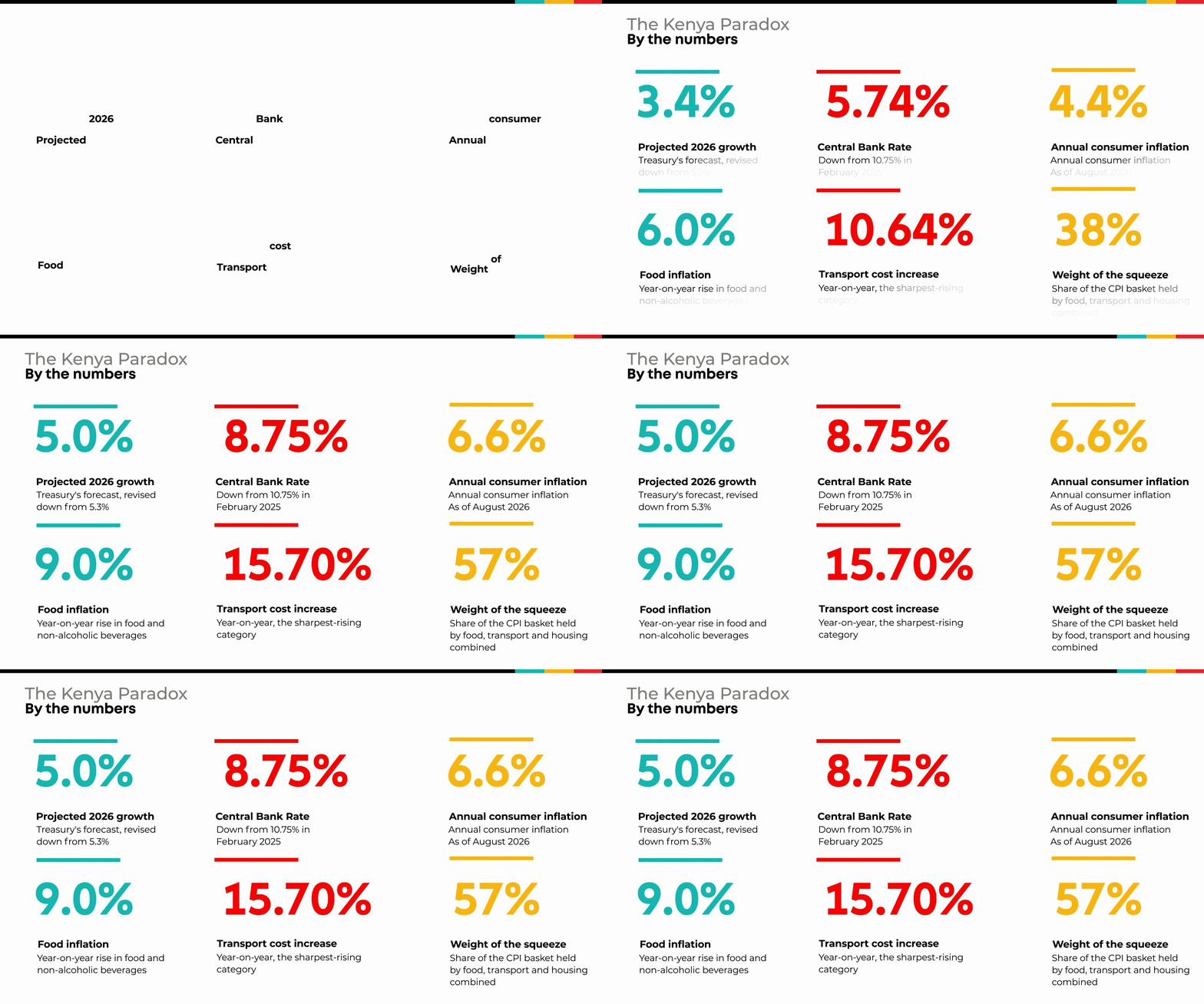
In 2025, Kenya’s economy grew by 4.6% following 4.7% growth in 2024. For 2026, the National Treasury is projecting 5.0% growth, although it has revised its earlier 5.3% forecast downwards in response to external pressures, including higher energy prices and geopolitical uncertainty. At the same time, the Central Bank of Kenya has significantly eased monetary policy. The Central Bank Rate fell from 10.75% in February 2025 to 8.75% by February 2026, where it remained through August.
On paper, these are encouraging signals. But there is another side to the story.
In August 2026, annual consumer inflation stood at 6.6%. Food and non-alcoholic beverages were up 9.0% year-on-year, while transport costs increased by 15.7%. Housing, water, electricity, gas and other fuels rose by another 3.6%. For households, the reality is therefore more complicated.
Kenya is navigating two economic realities at once: a growing economy and continued pressure on the household budget. And for marketers, that distinction matters.
The question is no longer simply: “Is the economy growing?”
It is: “How does that growth translate into the way consumers behave, spend and make decisions?”
What's Changing?
The consumer is becoming more digitally empowered — but not necessarily more financially carefree
Kenya's digital economy continues to expand the number of ways consumers can discover, compare and interact with brands.
Data Reportal's Digital 2026: Kenya report recorded 23.4 million internet users in Kenya in October 2025,
equivalent to 40.5% internet penetration. It also recorded 18.4 million social media user identities, with social media identities increasing by 34.6% between late 2024 and the end of 2025.
That means the modern Kenyan consumer has more opportunities than ever to research a product before
buying it, compare alternatives, ask for recommendations, read reviews and engage directly with brands.
But greater digital access does not automatically mean greater purchasing power.
A consumer can be highly active online while still thinking twice before making a purchase.
They can watch the advert, visit the website, compare three competitors and still decide to wait.
That is where the paradox becomes commercially important.
01 — Value is becoming a brand conversation, not just a pricing conversation.
When household budgets are under pressure, consumers become more deliberate about what deserves their money. But that does not necessarily mean brands need to compete purely on price.
The opportunity is to make value easier to understand:
- Why is this product worth paying for?
- What does the consumer get beyond the basic function?
- Does it save time?
- Last longer?
- Reduce another cost?
- Offer better convenience?
- Solve a more relevant problem?
02 — Smaller commitments can make bigger purchases easier.
When consumers are managing tighter cash flow, the barrier may not always be the total price of a product. It may be the size of the immediate commitment. This creates room for businesses to think about different routes into a purchase: smaller pack sizes, entry- level products, bundles, subscriptions, instalments or flexible payment options where appropriate. The opportunity is not necessarily to make the product cheaper. It is to make saying "yes" feel more manageable. This is particularly relevant in a market where inflation continues to affect some of the most frequently purchased household categories.
03 — Don't confuse digital attention with purchasing power.
Kenya's growing digital audience creates enormous opportunities for brands.
But an audience is not the same thing as a customer.
The 23.4 million internet users and 18.4 million social media user identities reported by DataReportal
illustrate the scale of the digital opportunity. The challenge is converting that attention into meaningful commercial action.
A consumer may see your TikTok. They may save your Instagram post. They may visit your website.
They may even ask a friend about the product.
None of those actions necessarily means they are ready to buy.
Brands therefore need to look beyond impressions, reach and engagement and understand what happens
between:
Attention → Consideration → Enquiry → Purchase → Repeat
The more financially cautious the consumer, the more important that journey becomes.

04 — Aspirational marketing still has a place.
The answer to household pressure is not for every brand to start communicating fear, scarcity and
financial anxiety.
Kenya remains an increasingly connected market with a growing digital audience and a resilient
economy. The National Treasury reports that the economy expanded by an average of 5.0% annually
between 2022 and 2025, despite a challenging external environment.
Consumers are not simply looking for brands that tell them times are difficult.
They are also looking for products, services and ideas that help them move forward.
That leaves room for ambition, aspiration and optimism.
The difference is relevance.
Aspirational creative does not have to ignore the consumer's reality. It can acknowledge where people are
while showing them where they could go.

What does this mean for your Brand ?
The economic environment suggests that consumers may be asking more questions before committing their money.
That puts greater pressure on brands to answer those questions clearly.
- Is the value obvious?
- Is the product relevant to what the consumer needs right now?
- Is there an easy way to try, buy or pay?
- Does the brand give consumers a reason to choose it over the alternatives?
And perhaps most importantly:
Does the marketing reflect the reality of the consumer rather than the reality the brand wishes they were living?
Four questions marketers should be asking
1. Is our value proposition obvious?
Can someone understand what they are getting for their money within seconds?
If your consumer needs to work too hard to understand the benefit, your marketing may be creating
friction where it should be removing it.
2. Are we giving consumers different ways to buy?
Depending on the category, consider whether smaller packs, entry-level options, bundles, subscriptions, instalments or flexible payment solutions could reduce the barrier to purchase.
3. Are we measuring what happens after engagement?
Reach and engagement tell you whether people noticed you. They do not necessarily tell you whether your marketing worked. Look at the relationship between media exposure, consideration, enquiries, transactions and repeat purchase.
4. Does our creative reflect the consumer's actual context?
Aspirational does not have to mean disconnected.
The strongest creative can acknowledge everyday realities while still giving consumers something to
believe in, aspire to or act on.
The takeaway
Consumers are not simply spending more or spending less. They are becoming more deliberate about
what they spend on and why.
The opportunity for brands is therefore not just to sell harder.
It is to communicate value better, reduce unnecessary friction and build propositions that make sense
within the consumer's actual world.
Because in this economy, attention may get you noticed. But relevance, value and trust are what can move
a consumer to act.
Sources: Kenya National Bureau of Statistics (KNBS), Central Bank of Kenya (CBK), National
Treasury and DataReportal. Data points reflect the latest available information as of September
2026.
Comments are closed