The Shift: Insights by The Digital Monkeys
The Attention Economy
Where does attention really go in 2026 and what makes it turn into preference?
What’s Changing?
For years, the growth story in digital was about getting more people online. That story is effectively over.
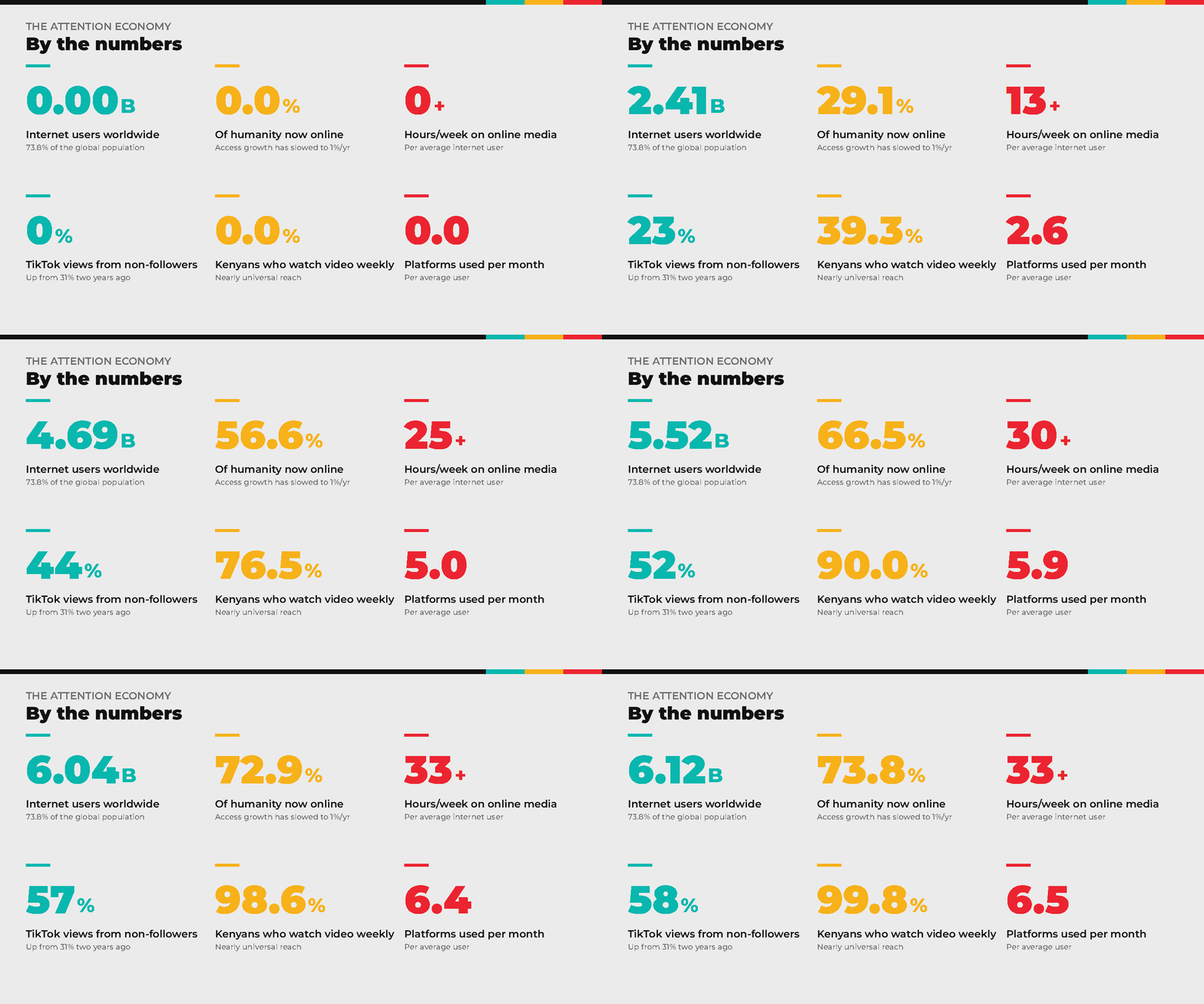
According to the DataReportal / Kepios Digital 2026 Mid-Year Global Update, there are now 6.12 billion internet users, 73.8% of the global population, and access growth has slowed to just 1% a year. The connected population is the population. But intensity is accelerating fast. The same report shows the average internet user now spends over 33 hours per week with online media, nearly 19 of them on social platforms. Generative AI has added 1.4 billion new monthly users in a single year, reaching 2.42 billion and reshaping how people search, discover, and decide.
The game has shifted from reaching new people to being present in existing routines.

Three structural moves are driving this:
Usage, preference, and potential ad audience have split into three different rankings.
According to GWI's Q4 2025 data, 56.3% of adults say they used Facebook last month, just one point ahead of YouTube. But YouTube reports a monthly ad reach of 2.65 billion, making it the largest buyable social audience anywhere.
Similarweb's App Intelligence index tells a different story again: YouTube sits at number 1, followed by WhatsApp and Instagram for reach, though messaging platforms now outscale social networks on actual app usage, yet sit outside most media-planning tools entirely.
DataReportal puts the average active user on 6.5 platforms monthly, and the overlap is enormous. You don't need to be everywhere for reach. You need to be everywhere where it matters for relevance.
Distribution is now interest-led, not network-led
Dash Social's research on social discovery shows that TikTok views coming from the For You page, i.e., from non-followers, grew from 31% to 58% between 2023 and 2025.
On Instagram, views from non-followers jumped from 30% to 49% in a single year. Every post is now auditioned independently. If most of your reach comes from people who don't follow you, follower growth is a lagging indicator, not a driver. Hootsuite's Social Media Trends 2026 report confirms the same pattern: historic audience size provides very little protection in an interest-graph world.
Closer to home, DataReportal / GWI Kenya’s report shows the average Kenyan social user is active 5.3 days per week, this is habit media, not campaign media. And 69.1% of Kenyan internet users research brands on social networks, above search engines at 48.4%. The discovery is happening on social, but it's being driven by content quality, not follower counts.
Video became the default grammar of the consumer internet.
The numbers here are staggering. According to DataReportal / GWI Kenya, 99.8% of Kenyan internet users aged 16+ watch online video weekly. 98.6% watch short-form video. Weekly time with online video in Kenya is nearly 22 hours, and more than half of that, almost 13 hours, is short-form video alone.
The spend is following. Global Ad Spend Forecasts (May 2026, covering 56 markets) show Connected TV ad spend growing 11.5% and digital video up 8.7% this year, against 0.0% growth for linear TV. And according to Sensor Tower's State of Mobile 2026, users spent 5.3 trillion hours in mobile apps globally in 2025, roughly 3.6 hours per person per day. Short video is no longer a format choice, it's the syntax.

What does this mean for your Brand ?
If you're planning from Nairobi, Kampala, or Dar, the implications are straightforward: your audience model, customer journeys, media plan and content strategy all need recalibration.

01 — Your audience model needs recalibration.
If your planning model is built around headcount, it is measuring the wrong thing. The real planning unit is intensity: how much time people spend online, how often they return, how many platforms they use, and what they are doing when they get there.
02 — Your customer journeys are probably broken on the right device.
96.2% of users go online via mobile in Kenya, that means a mid-range Android on mobile data. If your top five journeys don't work there, you're designing for a minority.
03 — Your media plan is likely misallocated.
Plans built on self-declared usage over-invest in platforms with weak buyable reach and under-invest in video. Build from reported ad reach in your actual markets.
04 — Your content model is built around followers who aren't driving your reach.
Plans built on self-declared usage over-invest in platforms with weak buyable reach and under-invest in video. Build from reported ad reach in your actual markets.
05 — Your video strategy is probably too narrow.
Plans built on self-declared usage over-invest in platforms with weak buyable reach and under-invest in video. Build from reported ad reach in your actual markets.

What Should You Do About It?
Thera are Several operational moves for Q3/Q4 2026.
1. Re-baseline your audience model on intensity metrics
Stop planning around headcount alone. Track time, frequency, platforms per user and the behaviours happening within those platforms. Set a single reference deck every team plans against.
2. Audit your top five customer journeys on a mid-range Android on mobile data.
Take the five journeys that matter most to your business. Time each one. Fix what's broken before Q4 spend kicks in.
3. Rebuild your platform mix from reported ad reach in your own markets.
Pick one reach platform. Give every other platform a specific role.
4. Add a messaging line to the plan.
Messaging is no longer an afterthought.
WhatsApp outscales most social networks on usage. If it's not on the plan, it's not resourced.
5. Move follower growth to a supporting KPI.
Lead with non-follower reach, watch time, completion, saves, and shares. Give the board one composite "earned attention" number.
6. Commission a video system, not a video campaign.
Plan the shoot around a content ecosystem.
Hero, explainer, proof, reactive, one shoot cycle. Captions and a spoken topic mention in the first five seconds, minimum.
7. Test one CTV or premium-video by this quarter.
Don't wait for the 2027 media plan to decide whether premium video belongs in your mix.
Test it now.
Measure it against your linear benchmark. You need the learning before 2027 planning.
Comments are closed